Principles and Guidelines for UN Peacekeeping Operations

Portada del curso

4.88 estrellas desde 1311 Evaluaciones

Vista preliminar del curso (PDF)

Descripcion del Curso

Free Tuition for All!

This course has been developed in consultation with the Peacekeeping Best Practices Section of the UN Department of Peacekeeping Operations’ Policy, Evaluation and Training Division. It is based on the internal DPKO/DFS publication entitled United Nations Peacekeeping Operations: Principles and Guidelines, which is more widely known under its informal name Capstone Doctrine. This publication is a comprehensive document that defines and promulgates available peacekeeping doctrine, definitions, procedures, and policy. In ten chapters, it introduces the concept and evolution of UN Peacekeeping, explains the decision process that precedes the deployment of a peacekeeping operation, and then the planning process to implement that decision. It also discusses the art of successful mandate implementation and addresses the management of peacekeeping operations, how operations are supported and sustained, and how they are concluded at their termination. The Institute course Principles and Guidelines is designed to teach this DPKO doctrine to all UN personnel serving in the field and at Headquarters, as well as to those who are new to UN peacekeeping. Ten chapters.

Número de páginas: 208 [Inglés]

Editorial: Instituto para Formación en Operaciones de Paz (POTI) [09-11-2010]

En este curso se incluyen las siguientes herramientas complementarias:

Vídeos

Ver videos sin costo disponibles con el curso.

4.88 estrellas desde 1311 Evaluaciones


Formación a distancia

GRATIS

Acceder a un libro de texto en línea (PDF) y a recursos pedagógicos virtuales.


Formación en línea y libros impresos

$100.00 USD*

Libro de texto físico con acceso a recursos pedagógicos virtuales.

*Los gastos de envío no están incluidos.

Certificado de Aprobación

Cada curso de POTI otorga un Certificado de Aprobación el cual permite a los estudiantes documentar su aprendizaje y sus logros. Debe aprobar el examen final con un puntaje de 75% o superior para garantizar la obtención de este registro perdurable de sus estudios.

Todos los certificados contienen el logotipo oficial de POTI y en aquellos certificados de cursos desarrollados en asociación con terceros se destaca dicha asociación. Todo certificado es verificable por medio de un número de serie único, garantizando así la legitimidad del documento.

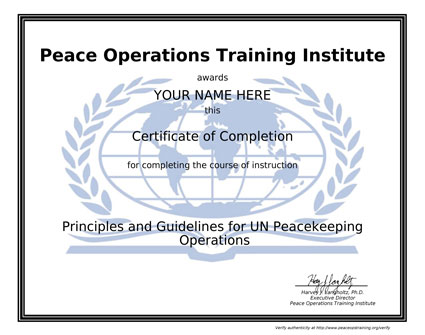
Example of a course certificate.
Certificado de muestra
Portada del curso

4.88 estrellas desde 1311 Evaluaciones

Vista preliminar del curso (PDF)

Descripcion del Curso

Inscription gratuite pour tous!

Ce cours a été développé en consultation avec la Section des pratiques optimales de maintien de la paix de la Division des politiques, de l’évaluation et de la formation du Département des opérations de maintien de la paix de l'ONU. Il est basé sur la publication interne du DOMP/DAM intitulée Les Opérations de Maintien de la Paix des Nations Unies: Principes et Orientations, qui est plus largement connu sous son nom informel de Doctrine Capstone. Cette publication est un document exhaustif qui définit et promulgue les doctrines, définitions, procédures et politiques disponibles sur le maintien de la paix. En dix chapitres, elle introduit le concept et l'évolution du maintien de la paix des Nations Unies, elle explique le processus de décision qui précède le déploiement d'une opération de maintien de la paix et ensuite le processus de planification pour mettre en œuvre cette décision. Elle traite également de l'art de la mise en œuvre réussie de mandat et traite de la gestion des opérations de maintien de la paix, de comment les opérations sont prises en charge et soutenues, et de comment elles sont bouclées à leurs fins. Le cours Principes et Orientations de l'Institut est conçu pour enseigner cette doctrine du DOMP à tout le personnel des Nations Unies servant sur le terrain et au siège, ainsi qu'à ceux qui sont nouveaux dans le maintien de la paix de l’ONU. Dix chapitres.

Number of pages: 212 [French]

Publisher: Peace Operations Training Institute [30-09-2013]

4.88 Stars from 1311 Reviews


Online Training

FREE

Access to an online textbook (PDF) and virtual study resources.


Online Training & Printed Textbook

$100.00 USD*

A physical textbook with access to virtual study resources.

*Shipping costs not included.

Certificate of Completion

Each POTI course offers a certificate of completion, allowing students to document their learning and achievement. Pass the final exam with a score of 75% or above to secure this lasting record of your studies.

All certificates contain the official POTI logo, and certificates for courses developed with partners also highlight that partnership. Each certificate is verifiable by a unique serial number, ensuring the legitimacy of this record.

Example of a course certificate.
Sample certificate

4.88 Stars from 1311 Reviews

Student reviews can only be submitted by a student after completing the course. Student reviews represent the combined opinions of the English version and all translated versions of the course.


5 Stars

"I appreciated several aspects of this course: Key Strengths 1. *Comprehensive Overview*: The course provided a thorough introduction to the principles and guidelines governing UN peacekeeping operations, covering essential topics such as the evolution of peacekeeping, the role of the Security Council, and the importance of impartiality and consent. 2. *Clear and Concise Language*: The course materials were well-written, making complex concepts accessible to learners with varying levels of experience and knowledge. 3. *Relevant Examples and Case Studies*: The inclusion of real-world examples and case studies helped illustrate key concepts and principles, making the course more engaging and interactive. 4. *Focus on Critical Issues*: The course addressed critical issues in peacekeeping, such as protection of civilians, humanitarian access, and gender mainstreaming. Additional Comments 1. *Interactive Elements*: Incorporating more interactive elements, such as quizzes, group discussions, or scenario-based exercises, could enhance learner engagement and retention. 2. *Guest Lectures or Expert Insights*: Featuring guest lectures or expert insights from experienced peacekeeping practitioners or scholars could provide valuable perspectives and enrich the learning experience. 3. *Real-World Applications*: Providing more opportunities for learners to apply theoretical knowledge to real-world scenarios or case studies could help reinforce learning and promote practical skills development. 4. *Continuous Updates*: Regularly updating the course materials to reflect evolving peacekeeping challenges, best practices, and lessons learned would ensure the course remains relevant and effective. Overall, the course provided a solid foundation for understanding the principles and guidelines governing UN peacekeeping operations. With some additional interactive elements, expert insights, and real-world applications, the course could be even more effective in engaging learners and promoting practical skills development."

Reviewed: 02-01-2025


5 Stars

"Le cours été fourni en information, il nous a permis d’enrichir nos connaissances."

Reviewed: 16-12-2024


2 Stars

"J'ai vraiment aimé le contenu du module, j'ai pris connaissance du mode opératoire et le principe d'une opération de maintien de la Paix des nations unies avant."

Reviewed: 14-12-2024


5 Stars

"all course is good enough"

Reviewed: 09-12-2024


5 Stars

"highly recommended course for every military personnel"

Reviewed: 05-12-2024