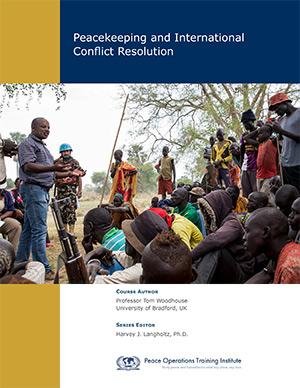
The overall aim of this course is to provide the student with a basic understanding of the field of conflict resolution and its application, both theoretically and practically, to peacekeeping intervention in contemporary international conflicts. The course explores the emergence and development of the academic discipline of conflict resolution and its relation to the evolution of peacekeeping. The nature of conflict and the dynamics of contemporary conflict are defined, along with the key concepts and techniques for resolving conflict. The course explores the significant areas that will improve responses to today’s complex emergencies, including conflict analysis and mapping, early warning and conflict prevention, contingency and complementarity approaches, interagency coordination, post-conflict peacebuilding and reconciliation, cultural understanding, and gender awareness.
The 2020 edition of this course covers the continued development of peacekeeping doctrine, theory, and practice in relation to the role of conflict analysis and resolution on the ground. It also offers new insights into the impact of information and communication technology on peacekeeping and conflict resolution — for example, the increasing use of unmanned aerial vehicles on mission and e-peace simulations to help train peacekeepers.
Lessons: 10
Number of pages: 260 [English]
Estimated reading time: 14 hours
Publisher: Peace Operations Training Institute [12-10-2020]