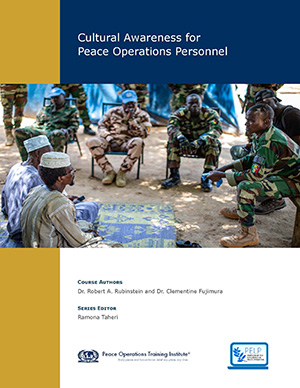
Cultural Awareness for Peace Operations Personnel

Description du cours

New Course!

About the Course: This course is designed to provide peace operations personnel with a foundational understanding of culture and the multifaceted role of cultural awareness in peace operations. A deep understanding of local culture is critical in peace operations. Understanding the “why" of culture that leads people to act as they do opens doors to trust and fosters collaboration with local communities. This course examines how culture influences peace operations, both within a mission and between mission organizations. This course also examines cyber and digital impacts on peacekeeping missions. Peacekeepers face a complex array of challenges stemming from evolving conflicts, potential geopolitical shifts, and operational constraints. This course offers peace operations personnel a valuable understanding of how cultural competence enables effective operations in the complex, hybrid realities of modern conflict. Five Lessons. .

About the Authors:
Dr. Robert A. Rubinstein (Ph.D., State University of New York at Binghamton) is an anthropologist with expertise in political and medical anthropology and in social science history and research methods. Rubinstein focuses on cross-cultural aspects of conflict and dispute resolution, including negotiation, mediation, and consensus building. He is an originator of the field of the anthropology of peacekeeping. He has conducted empirical research and policy studies in this field. Rubinstein has collaborated on policy applications of his work with the International Peace Academy, the United Nations Department of Peacekeeping Operations, the United Nation Office of Internal Oversight Services, and the United States Army Peacekeeping Institute. He has conducted overseas research in urban and rural Egypt, Belize and Mexico, and in the United States. Rubinstein has published more than 100 articles in journals and books. He is the author or editor of nine books and research monographs, including Peacekeeping Under Fire: Culture and Intervention, Building Peace: Practical Reflections from the Field, Dangerous Liaisons: Anthropologists and the National Security State, and Practicing Military Anthropology: Beyond Traditional Boundaries and Expectations.

Dr. Clementine K. Fujimura (Ph.D., the University of Chicago) is an anthropologist whose career bridges academia, leadership development, and applied military education. A Professor in the Leadership, Ethics, and Law Department at the U.S. Naval Academy, she has spent most of her career teaching and researching how culture shapes leadership, organizational behavior, and ethical decision-making in global and operational contexts. Her scholarship, which has resulted in numerous publications including Practicing Military Anthropology, Developing Cross-Cultural Competence for Leaders, and Foundations in Cyber-Ethnography, examines the intersections of anthropology, digital culture, and military practice. Her focus on developing cultural acuity among officers and educators involves designing courses and workshops by embedding ethnographic insight into leadership curricula and study-abroad initiatives. Her work, spanning research on Russian youth, veterans’ well-being, and cyber-cultural engagement, reflects a lifelong commitment to fostering adaptive, empathetic, and culturally intelligent leadership in higher education and the armed forces.

Nombre de pages: 86 [Anglais]

Editeur: Institut de formation aux opérations de paix (POTI) [08-12-2025]

Formation en ligne

$75.00 USD

Accès à un manuel en ligne (PDF) et à des ressources d’étude virtuelles.


Formation en ligne et manuel imprimé

$100.00 USD*

Un manuel classique avec accès à des ressources d’étude virtuelles.

*Les frais de livraison ne sont pas inclus.

Certificat de réussite

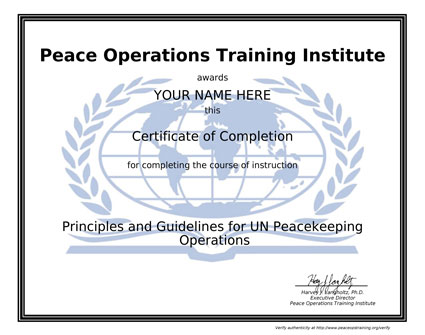
Chaque cours POTI délivre un certificat de réussite, permettant aux étudiants de documenter leur apprentissage et leurs résultats. Réussissez l’examen final avec une note de 75% ou plus pour obtenir ce certificat attestant de vos études.

Tous les certificats comportent le logo officiel du POTI, et les certificats pour les cours développés avec des partenaires mettent également en avant ce partenariat. Chaque certificat est vérifiable grâce à un numéro de série unique, garantissant ainsi sa légitimité.

Example of a course certificate.
Exemple de certificat
Avis sur les cours

5 Étoiles de 2 Avis

Les avis des étudiants ne peuvent être soumis qu’après avoir achevé le cours. Les avis des étudiants représentent les opinions combinées de la version anglaise et de toutes les versions traduites du cours.


5 Étoiles

"excellent"

Disposant d’un avis: 16-01-2026


5 Étoiles

"I've really appreciated the emphasis on cultural awareness and its impact on peacekeeping operations. The course has helped me understand the importance of empathy and adaptability in complex cultural contexts. I've also enjoyed exploring the intersection of technology and culture in peacekeeping."

Disposant d’un avis: 02-01-2026