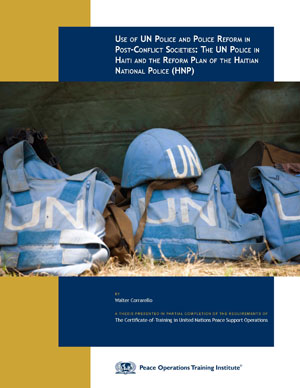
Use of UN Police and Police Reform in Post-Conflict Societies: The UN Police in Haiti and the Reform Plan of the Haitian National Police (HNP)
Tesis de COTISPO: Aprobado
Estudiante: Corrarello, Walter
Fecha de Aprobación: Nov 2007
Un extracto de la tesis:
For most of its troubled history, Haiti has been the poorest country in the western hemisphere. Politically, until very recently, Haiti had never experienced a democratic political transition. More recently, from 1986 to 1990, Haiti was ruled by a series of provisional governments. In 1987, a new constitution was ratified, providing for an elected bicameral parliament, an elected president and a prime minister, cabinet ministers, and supreme court appointed by the president with the consent of the parliament. The Constitution also provided for political decentralization through the election of mayors and administrative bodies responsible for local government. At the first elections under the new constitution, in December 1990, Jean-Bertrand Aristide, a charismatic Roman Catholic priest, won 67% of the vote in elections that international observers deemed largely free and fair.